Artificial intelligence is no longer something that belongs to the future. It is already changing how businesses communicate, make decisions, analyze information and operate — and the construction industry is no exception.
From estimating and preconstruction to project management, documentation and communication, AI is becoming another tool available to contractors.
But like any tool, the value of AI depends on how it is used.
For commercial construction companies, the question is no longer simply, “Should we use AI?”
The better question is:
“How do we use AI to become better without allowing technology to replace the experience, relationships and judgment that great construction requires?”
How AI Is Helping Commercial Construction
One of AI’s greatest advantages is its ability to process large amounts of information quickly.
Construction projects generate enormous amounts of data — drawings, specifications, estimates, schedules, contracts, RFIs, submittals, meeting notes, change documentation and more.
AI can help teams organize and analyze that information faster.
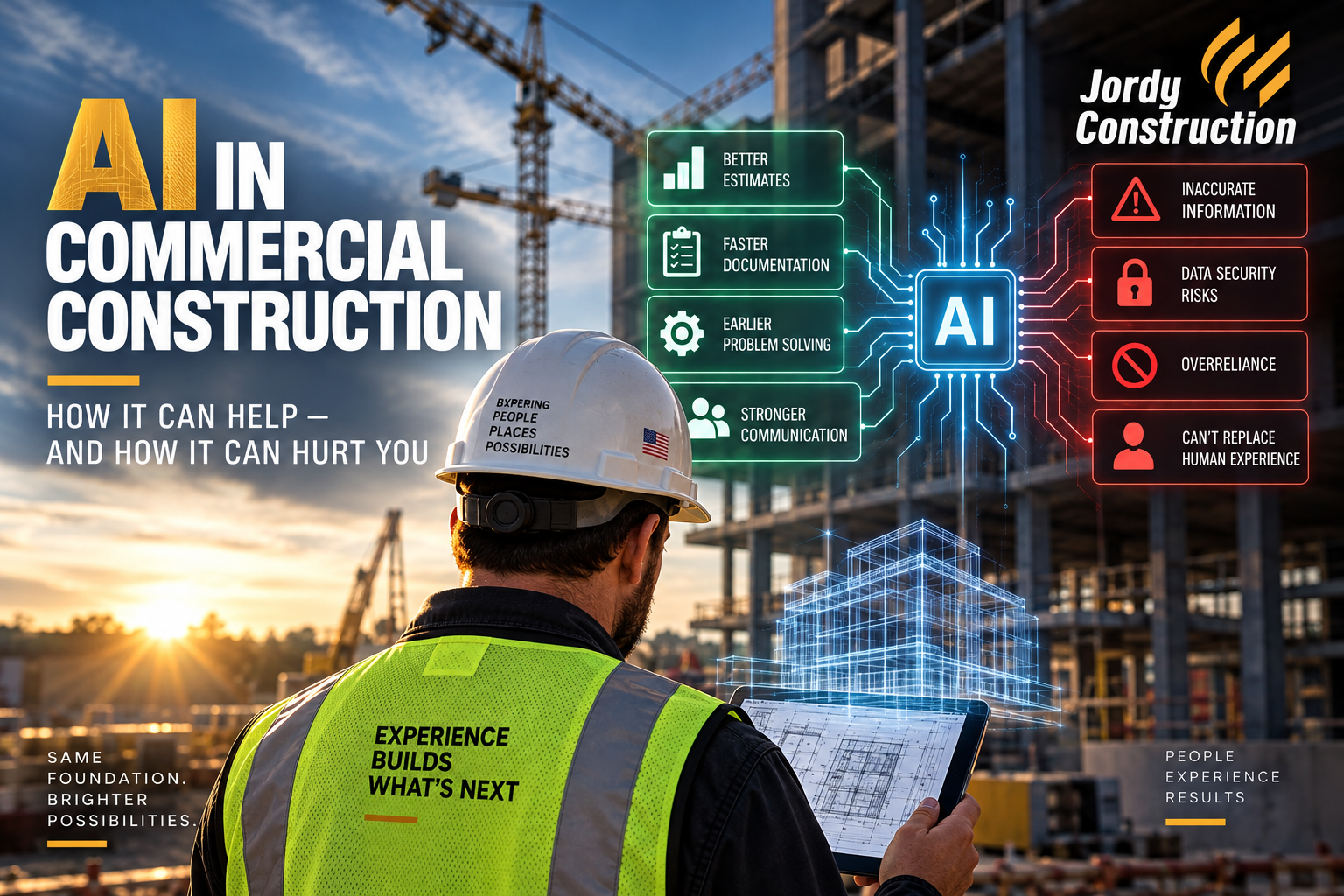
1. Preconstruction and Estimating
AI is increasingly being incorporated into estimating and preconstruction technology.
It can help teams review information, identify potential discrepancies, compare documents and organize project data before construction begins.
That can make preconstruction teams more efficient and potentially help identify issues earlier.
But an AI-generated estimate is only as valuable as the information behind it.
Experienced estimators still need to understand the project, the market, constructability, subcontractor relationships and the realities of building in the field.
AI can assist the estimator.
It should not replace the estimator.
2. Project Documentation
Project teams spend a significant amount of time documenting what happens throughout a project.
AI can help organize meeting notes, summarize documents, search specifications, identify deadlines, prepare reports and turn large amounts of project information into something easier to understand.
The benefit isn’t simply doing more work.
It is giving people more time to focus on the work that requires human judgment.
3. Identifying Problems Earlier
One of the biggest opportunities for AI may be its ability to recognize patterns across large amounts of information.
When properly implemented, AI can help teams identify inconsistencies, missing information, schedule concerns or potential project risks earlier.
In construction, solving a problem early is almost always easier than solving it in the field.
Technology that helps teams ask better questions earlier can be extremely valuable.
4. Communication
Construction is a people business, but communication is also one of its biggest challenges.
Owners, architects, engineers, general contractors, subcontractors and vendors may all be working from different information.
AI can help summarize documents, organize communication and make information easier to find.
But this is also where companies need to be careful.
Faster communication does not automatically mean better communication.
Sometimes a phone call, jobsite conversation or face-to-face meeting is still the best technology available.
Where AI Can Hurt a Construction Company
The advantages of AI are significant, but so are the risks.
AI Can Be Wrong
AI can produce information that sounds completely confident and professional while still being inaccurate.
In construction, that matters.
An incorrect interpretation of a specification, contract requirement, quantity, schedule or scope can have real financial consequences.
AI-generated information should therefore be treated as information to review — not automatically as fact.
AI can provide an answer. Experience determines whether it is the right answer.
Confidential Information Can Be Exposed
Construction companies work with sensitive information every day.
Project budgets, contracts, drawings, client information, pricing, employee information and proprietary business information should not automatically be uploaded into an AI platform.
Before using AI with confidential project information, companies should understand how the platform stores, processes and protects that data.
Convenience should never come at the expense of a client’s trust.
AI Cannot See Everything Happening on a Jobsite
Construction happens in the real world.
Conditions change.
People make decisions.
Weather changes.
Existing conditions are uncovered.
Subcontractors coordinate.
Owners change direction.
Problems happen that were never visible on a drawing or spreadsheet.
AI can analyze information about a project.
It cannot replace an experienced superintendent walking the project, a project manager understanding the owner or a construction professional recognizing that something simply doesn’t look right.
Overreliance Can Become a Problem
Perhaps one of the greatest risks isn’t AI itself.
It’s becoming too dependent on it.
Construction knowledge is developed through years of experience — solving problems, working with trades, understanding sequencing, communicating with owners and learning from previous projects.
If technology becomes a substitute for developing those skills, the industry could become faster while simultaneously becoming less knowledgeable.
That is not progress.
The Future Isn’t AI vs. People
At Jordy Construction, we believe technology should support people — not replace the relationships and experience that successful construction is built upon.
AI will continue to become more capable.
The contractors who succeed will likely be the ones who understand how to combine new technology with something technology cannot easily reproduce:
Experience. Accountability. Relationships. Trust.
A computer can analyze thousands of documents.
It cannot shake an owner’s hand.
It cannot walk onto a jobsite and understand the personalities of everyone working there.
It cannot build decades of relationships with subcontractors and partners.
And it cannot take responsibility when a difficult decision needs to be made.
People do that.
Building Smarter Without Losing What Matters
Construction has always evolved.
The tools have changed. Materials have changed. Safety has improved. Project management has become more sophisticated. Information moves faster than ever.
AI is another major step in that evolution.
We should use it.
We should learn from it.
We should understand its limitations.
And we should never allow it to replace the human relationships that construction has always depended on.
Because ultimately, buildings aren’t built by artificial intelligence.
They’re built by people.
And the best technology in the world is most powerful when it’s placed in the hands of experienced people who know how to use it.